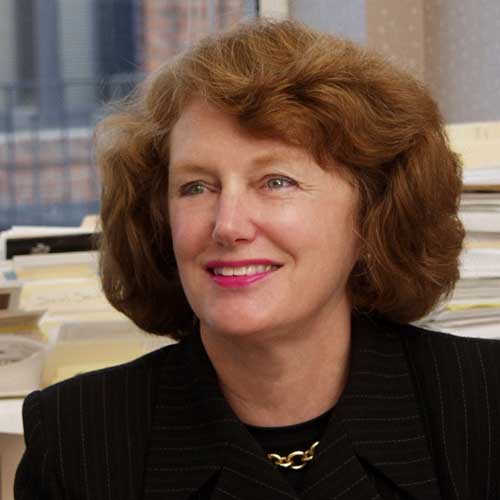
Giachino (00:04.0949 - 00:33.0994)
Welcome to IP Protection Matters. I'm your host, Renee Giachino.
Today, we are joined by Sally Pipes, President, CEO and Thomas W. Smith Fellow in Health Care Policy at the Pacific Research Institute. We will be talking today about the impact of foreign price controls on innovation, how the American market achieved pharmaceutical supremacy and how we can keep it.
Sally, welcome to IP Protection Matters. It's a pleasure to have you join me.
Pipes (00:34.0185 - 00:36.0564)
Thank you, Renee. It's always great to chat with you.
Giachino (00:36.0985 - 00:52.0044)
Sally, I like to start these discussions by asking some fairly simple questions that probably have difficult answers. Why should we care about IP protections? In other words, why does IP protection matter?
Pipes (00:52.0424 - 02:12.0940)
It is very important because, as you know, it's very expensive to do the research for a drug and then bring it to market. It takes 10 to 15 years from an idea to bring a drug through all the trials to market. It costs between $2 to $3 billion . Roughly 90% of the drugs that come [then] fail. So we have to give some protection to those people who are taking the risk through patent protection.
Under the Inflation Reduction Act, the patent protection for small molecule drugs, the ones that you take at home or by mouth, is 9 years. They extended that for biologics to 13 years. I, of course, wish that they would do both for 13 years, but we have to have patent protection in order to keep America being the world's medicine chest.
About 80% of all research and development into drugs is done in this country. Not in Europe. Not in the UK where price controls are in effect. It was the Bayh-Dole Act of 1980 that allowed this patent protection to move forward.
Giachino (02:13.0369 - 02:57.0949)
We're going to talk a little more about the Bayh-Dole Act in a couple of minutes, but I want to go back to something else that you just referenced. That is how the U.S. system, our system of private, market-based pricing, has been the foundation for America's global leadership in many fields, including, as you referenced, biomedical innovation.
Yet we are seeing today, and I keep reading a lot about efforts to import foreign price controls from these wealthy foreign trade competitors. Sally, I think folks have heard the term “most-favored-nation.” What would importing that into the United States mean for innovation and the value of our intellectual property?
Pipes (02:58.0240 - 05:04.0640)
Most Favored Nation, or "MFN" as you mentioned, is supported in a big way by President Trump. He thinks drug prices are too high and that if you bring in most-favored-nation price controls, it will cause our drugs in this country to be cheaper. If you look at TrumpRx, which was launched on February 5th, his website is tied in to the prices being most-favored-nation prices. Most-favored-nation prices are price controls on pharmaceuticals.
Countries like Britain, France and Germany all have price controls and, therefore, the prices that they offer for drugs are cheaper. But they are free riding off our research and development. We want to keep the market open. If you look at the developments between the new drugs developed between 2012 and 2021, only 59% were available in the UK, 28% in Canada where I'm from, yet 85% of these drugs were available in the U.S.
When you bring in price controls, as Tomas Philipson at University of Chicago has said, we're going to see a reduction of about 135 fewer drugs over the next decade. We've already seen, because of this threat of MFN, 55 research projects halted and 26 medicines have been abandoned. We do not want price controls. We don't want most-favored-nation.
What we should be doing is setting up trade agreements between the countries that we want to do business with. These countries should be paying higher prices to help to cover our R&D rather than having them free ride off of us. Foreign controls, [or] price controls, are the wrong way to proceed. We need Milton Friedman back, Renee, in order to talk about the role of competitive markets. When you have competition and markets, prices will come down and you will have more of a supply.
Giachino (05:04.0899 - 06:33.0399)
Our timing is great because just this week, your organization, the Pacific Research Institute, together with my organization signed on to a letter that has over 50 organizations writing to the U.S. Congress opposing the codification of most-favored-nation prescription drug pricing. As you've pointed out, rather than undermining innovation by putting into place MFN, the efforts that you just recently referenced would in fact bring a stop to the freeloading that many of these countries have [done]. They are not paying their fair share. Ideas like you just suggested would help with that. I think [we could] most certainly turn this around without having to codify MFN.
I want to talk a little bit now about how if in fact the US were to adopt any of these price controls, much as Europe did, [we could] see history repeat itself and the U.S. ultimately end up as Europe now has become. We'll go back and talk about history, but the U.S. in the late 20th century took over as the leaders in the arena of innovation. Do you think that if we were to adopt these price controls that we could eventually see ourselves lose that leadership? And if we do, who's going to take that lead?
Pipes (06:33.0859 - 09:36.0719)
In America we have been the global leader in pharmaceutical innovation. That was by design because by 2005 all the countries in Europe had price controls. Each country in Europe that had drugs had price controls. So this really allowed America to move ahead. 80% of the research and development today on pharmaceuticals, biologics, is done in this country. If the MFN policy is totally adopted, we are not going to be the world leader. And the question is who is that going to be? Is it going to be China? Is it going to be Mexico? We hope not. We want to keep this pipeline for pharmaceuticals open.
We want America to continue to be the world's medicine chest. Price controls going back to Diocletian's time have never ever worked, and they won't work. It's going to lead to a reduction in this innovation which allows us to benefit from the latest research and development, whether in oncology, drugs for strokes, heart, Alzheimer's, all of these. The R&D is being done here in firms here in America.
In the past, before America got into this in the 30s and 40s, Britain and European countries were the cutting-edge leaders. We saw a lot of great inventions for pneumonia - the Salk vaccine. All of these things were developed. We want to continue that because we want to be able to live longer and healthier lives. If we continue with these price controls, it's going to ruin this pipeline. The Inflation Reduction Act (IRA) that President Biden signed into law is another price control measure where price controls started this January 1st on 10 drugs under Medicare Part D. Then January 1st, 2027, they're going to add 15 drugs. By January 1st, 2028, 15 drugs under Medicare's Parts B and D will be under price controls.
This is all getting the camel's nose under the tent through two different ways - MFN and IRA price controls. I want to spend my latter days fighting this because we want to keep the market open. It's so important for our long-term health. We just don't want to destroy it because it was destroyed in these European countries and we were able, by design, to pick it up. You look at companies like Roche, AstraZeneca, these are all European countries that had great research and development. By the time 2005 came around, they all had price controls and they moved their manufacturing and their R&D to this country. They're not in France, Switzerland and the UK.

Giachino (09:37.0330 - 10:15.0609)
In your book, The World's Medicine Chest: How America Achieved Pharmaceutical Supremacy and How to Keep It, you outline and give a great history lesson to us in terms of the evolution of pharmaceutical innovation. In the 1970s, Europe was the global hub for pharmaceutical innovation, but how that has changed. The shift occurred and it became here in the United States. In your book, you devote an entire chapter to how in the long run these price controls actually cost us more. How is that, Sally?
Pipes (10:15.0770 - 11:34.0729)
Price controls cost us more, particularly in terms of life, because if we don't have the latest cancer drugs - oncology drugs, genome things - it is going to cost us in terms of human life because we won't have the cures that are out there. We look at the GLP-1s. So many people are benefiting from these weight loss drugs. They also help solve other healthcare problems. When competition opened up between [Eli] Lilly, Novo, and Moderna, the price of these GLP-1s started to come down, making them more available and more affordable to a much wider audience.
As Milton Friedman says, capitalism has no nationality. Competition will allow us to benefit from more goods at lower prices. Price controls are the exact opposite. They destroy the market. The pharmaceutical/biologic sector is a huge employer in this country. We want to have good job creation. We want to have people employed and we want to keep this market open.
Giachino (11:35.0419 - 12:04.0859)
Let's go back to the Bayh-Dole Act - a bipartisan effort that became law in the 1980s - and today it is under attack.
In a nutshell, how did granting universities and nonprofits the ownership of their patents and financial incentive to license their intellectual property to private companies impact innovation? In other words, I could say, as you have said before and written recently, how did it become a win-win-win?
Pipes (12:05.0010 - 14:07.0659)
Yes. It is a win-win-win. Howard Lutnick, who is the Secretary of Commerce and a former executive in the financial services sector, is a huge proponent of tariffs and taxes. So, he is proposing a 50% excise tax on the revenue that academic institutions derive from licensing research breakthroughs to private companies. It's a completely misinformed idea. It's one that would endanger the health and prosperity of the very taxpayers he claims to defend.
Under the Bayh-Dole Act - that was Evan Bayh from Indiana and Bob Dole from Kansas - that Act granted the universities and nonprofits behind the discoveries that we're talking about, the ownership of patents. It created a financial incentive for these academic institutions to license intellectual property to private companies. From there, these firms could invest the time and resources needed to turn that research into practical services and medicines. It's a win-win.
His point is if we fund it and they invent a patent, the United States of America taxpayers should get half the benefit. Well, that just isn't right. This whole idea is ridiculous, and I hope that it's not going to go anywhere because it's going to destroy all of the scientists at academic institutions who are doing such great work. Look at Sergey Brin and Larry Page of Google. They started out in a university lab. Look what happened to Google. It is very important that we allow innovation to thrive and not start putting excise taxes, which will destroy this and destroy a lot of the research that is going on in these academic institutions.
Giachino (14:07.0669 - 15:14.0169)
It's fascinating because in a recent editorial that you wrote where you talk about the system that was established by the Bayh-Dole Act, [you say] it's helped to launch more than 19,000 startups since 1996. Numbers speak for themselves. You also noted that it supported around 6.5 million jobs - people don't always think about it as jobs - as well as $1.9 trillion in gross industrial output.
Again, as you just pointed out with the Bayh-Dole Act, the benefits are more than just economic. We have so many of the products that we have today, these high-tech products that we take for granted from your high-definition television to the first HIV and AIDS therapies to our search engine Google that most of us use on a daily basis, these wouldn't exist without the law's infrastructure for the technology transfer that we're talking about. So all that, Sally, to ask you, is federally-funded science a raw deal for taxpayers and consumers in your opinion?
Pipes (15:14.0409 - 16:24.0679)
No, I think I think it's a great part of something that is so important for scientists and academics who are toiling away in the fields and in their research labs. We need to allow them to continue to do the great work because it's going to benefit all of us. If federally funded science is really a raw deal, as Howard Lutnick seems to think, he says if we fund it and they invent a patent, the U.S. should get half the benefit. This is just completely wrong and it's going to endanger the health and prosperity of the very taxpayers that he wants to defend.
As I say, he's a big proponent of the excise tax. He's a big proponent of tariffs, and these are not the way to American prosperity and should really not be on the agenda of Republicans. These are ideas of Democrats and democratic progressives. We want more innovation, not less. We don't want fewer discoveries, fewer technological advances. We want to improve our quality of life by more discoveries, more advances and more innovation.
Giachino (16:25.0400 - 16:40.0530)
We've seen over the short period so far of this Trump Administration at a year into it that no time has been wasted in dismantling many of the failed Biden Administration policies. What would you put at the top of that list right now, Sally?
Pipes (16:40.0690 - 19:44.0949)
In health care in particular, I think Trump's point on the pharmaceutical side he said we want to fund patients, not the government, on the issue of the enhanced subsidies which expired under Obamacare at the end of December. And I hope they're not going to be renewed for another 3 years at a cost of $85 billion, Mr. Trump has said, we want the subsidies to go to individuals and not to the system or to government. This is putting patients back in charge of their healthcare. If you are able to put the subsidy that you receive into a health savings account, this is going to really be just a terrific advance for empowering patients and doctors.
So, I would say with that statement that President Trump does realize that we need to empower families and individuals and not the government. I think that was a very, very great statement that he made. Let's hope he follows through with it. Under TrumpRx, the government website that he launched February 5th, I'm very worried about that. I love the idea of direct-to-consumer sales, and he does too. We don't need another government middleman institution. We want to get rid of middlemen like PBMs that keep the cost of drugs for the patient high and allow the market to flourish.
If you look at direct-to-consumer sales, which will push out the pharmaceutical benefit manager (PBM), the middleman, we will see lower prices. Patients will benefit from those. So we want to make that available rather than bringing in another government institution. TrumpRx he says is not going to be selling drugs. What they're going to have is the drug companies, the AstraZenecas and the Pfizers, in the back end along with GoodRx. But people are smart. They can go online and pharma and many of the drug companies already have their own websites for direct-to-consumer sales. So I'm very worried myself personally about TrumpRx. I don't think we need it.
We do need to encourage direct-to-consumer sales. Get rid of these middlemen and give people the opportunity to get these drugs that are available and that we have access to. The whole idea of TrumpRx is he's saying that the prices will be tied to MFN as we've just talked about. Already many of the prices of the drugs under Medicare and Medicaid are already cheaper than they would be at the MFN price. People have to be really very careful and politicians have to understand what it is they're trying to do. A lot of this is not in the interest of patients and their long-term health.
Giachino (19:45.0609 - 21:10.0579)
That's why I would love to see this initiative continue to really take off in lieu of MFN. Let's have the MFP - the most-favored-patient. I know that a lot of individuals are familiar with [that initiative]. A lot of it is what you and I have been talking about.
If people want to learn more about it, I encourage everyone to visit mostfavoredpatient.org, a wonderful initiative that has been underway for up close to a year now, where it talks about how to achieve these meaningful healthcare and drug policy reforms. They're encouraging things that you just talked about. Direct-to-consumer pharmaceutical purchasing. They're talking about ensuring that foreign nations pay at least their fair share for U.S. developed drugs, thereby discouraging this persistent free-rider problem that we've been talking about. Increasing the incentives for domestic research and development, which we need to continue to do for manufacturing and workforce growth for domestic employment, even for national security. Something we haven't really even talked about yet. Then as you mentioned, ensuring that those PBM operations are taken out of this equation.
All wonderful information. Sally, any parting thoughts before we end our discussion today?
Pipes (21:10.0910 - 21:56.0680)
Thank you for chatting with me, Renee. We have to get these messages out to educate the public because you go to a doctor's office, the ones that are still in private practice, don't like single payer healthcare. Yet they think Trump is doing a good job on bringing in price controls. They don't understand how this all comes to pass and how we are the world's medicine chest.
So, there's a lot of education that has to be done, and we just have to keep up the drumbeat and continue with this because we don't want to move to MFN price controls and destroy the goose that is laying the golden eggs for us, our long-term health, and living for a long time.
Giachino (21:57.0109 - 22:29.0704)
Thank you very much for your time today. Our guest has been Sally Pipes, President, CEO and Thomas W. Smith Fellow in Health Care Policy at the Pacific Research Institute.
Please pick up and read her book. It's critically important that we do continue to educate ourselves on this issue. The book is titled, The World's Medicine Chest: How America Achieved Pharmaceutical Supremacy and How to Keep It. Thank you again, Sally, for your time. We greatly appreciate all your work that you were doing to help educate us and others on these critically important issues.
Pipes (22:29.0864 - 22:36.0844)
Well, you're doing a great job too, Renee. So we have to keep up our partnership by keeping our finger in the dike to keep out bad policy.
Giachino (22:37.0064 - 22:39.0560)
Amen to that. Thank you so much, Sally.